Monday, 16 March 2020

The Holly leaf-miner

The leaf blotch made by the Holly leaf-miner

If you check out our one native species of Holly in Britain – Ilex aquifolium - then you are very likely to find our only native leaf-miner that lives on Holly. Not all things in natural history are that uncomplicated!!

The Holly leaf-miner - Phytomyza ilicis – is a tiny fly that spends most of the year living as a larvae or pupae “inside” the holly leaf, rather like a letter inside an envelope. There are many hundreds of species of leaf miner; not just flies however, as many are made by tiny moth species too.

The Holly leaf-miner lays its eggs in May and June, in the underside of a young Holly leaf. The eventual blotch on the leaf that the larvae make is green to start with, but over time it can often turn wine red. Also, usually there will be a dark spot in the middle of the leaf blotch, which is made up of frass (or poo) excreted by the larvae.


Some can turn a colourful red! 

Once you start to check out Holly to see if it has this little fly species, you will quickly realise just how common and widespread this species is – it seems to be on most Holly bushes and trees. You may never have noticed it before – but you will from now on!  


Tuesday, 10 March 2020

It's all about our consumption of red meat you know!! Or is it?

The UK cannot go climate neutral much before 2050 unless people stop flying and eating red meat almost completely, a report says.

The claim comes from the government-funded research group Energy Systems Catapult, whose computer models are used by the Committee on Climate Change, which advises government. It warns that livestock production for dairy and meat may need to be cut by 50% rather than the 20% currently envisaged by the Committee on Climate Change. 

But a spokesman from the National Beef association, Neil Shand, told BBC News that “scientific studies typically underestimate the role of livestock in capturing carbon in the soil”. He says this because British beef are largely grass fed and grassland is good at capturing carbon. 

He went on to say “It does seem rather unfortunate that the report links beef production and aviation in this way. The timing is more than a little ironic; the shops are full of people panic-buying and it seems clear that the nation’s food sector relies very heavily on imports, and the associated transport that brings them into the UK”.

However, much of the information you read about the planet-wrecking capability of cows is based on the most extreme scenario. I agree that cattle grazing pasture land in South America that used to be rain-forest, is massively destructive to biodiversity, coupled with the fact that the tree felling also releases a lot of carbon dioxide. 

Also, cattle kept on huge, very intensive coral type ranches in the US Midwest, do use a lot of water and create a large amount of pollution. 

But there is an easy way to avoid this – buy British. In Britain, beef cattle tend to be kept outdoors on permanent pasture. So the Government needs to differentiate between pasture fed UK cattle and those that are intensively raised overseas. They also need to factor in the transportation footprint of foreign raised beef.  

I wrote on this subject on the 17th February (see below) and still wonder why the Government bangs on all the time about “red” meat production being such a problem in this country? UK farming contributes 10% of the UK’s greenhouse emissions, with just 4.5% coming from livestock – that’s ALL livestock.


An English scene - not the sort of image normally portrayed of world beef production

The result of this bombardment is that British consumers are substituting red meat for chicken, in an effort to live a greener lifestyle. As Greenpeace has said “they may be unwittingly contributing to the razing of rain-forests”.

With sales of chicken rising in Britain, Greenpeace warned of the hidden climate impact of raising these birds, whose feed is mainly grown in South America. This means rising consumption could further endanger rain-forests, which are already shrinking by millions of hectares each year. 

Furthermore, a survey of 23 leading British supermarkets, fast-food restaurants and food companies found none were tracking whether soya used for animal feed in their supply chains was linked to deforestation.

The UK imports roughly 3.2 million tonnes of soya each year, with a further 600,000 tonnes already embedded in imported meat and other products. Approximately 68% of UK soya imports come from countries in South America, where soya is driving deforestation.

Chicken is by far the most popular meat in the UK – and the biggest driver of our soya consumption. The UK is the third largest producer of chicken in Europe, slaughtering over one billion chickens annually. People in the UK eat more than twice as much chicken as beef or lamb. Over the past 20 years, overall demand for beef, lamb and pork has fallen sharply, but this drop has been offset by a 20% increase in consumption of chicken – partly as a result of a switch from red meat driven by health and environmental concerns.

I said in my blog of the 11th February that the National Farmers Union president Minette Batters, announced the NFU’s ambition to achieve net zero carbon emissions for agriculture by 2040. I think that the Government can help farmers achieve this with some much clearer thinking, because at the moment there is a mass of confusion and misinformation driving peoples eating habits.  


Tuesday, 3 March 2020

My scruffy lawn has its pluses!


The local rookeries are now full of noise and endeavour as rooks go about restoring old nests and building new ones. Once the main structure of the nest is built of sticks and twigs, (many of which are simply stolen from a neighbours nest when they are not paying attention!) then the all important internal lining is next on the agenda.

This is where my lawn seems to offer all the perfect ingredients for a soft, warm interior lining for a rooks nest! Regular visitations are being made to gather grass, leaves and moss, ripped up with ease from my scruffy lawn using their long powerful beaks.

A beak full of lining material for a nest high up in the trees

Egg laying is probably already underway from those who have completed their nests, laying 3 or 4 greenish blue eggs, which are also marked with various brown spots and blotches across the shell.  Incubation takes around 16 days before the young hatch.

The nestlings will stay in the swaying nest for another 33 days or so before fledging.  There is a short time between completely leaving the nest and exploring the wider countryside, when the youngsters come out of the nest and explore the upper branches surrounding the nest, flapping wings to strengthen them ready for flight. These birds are known as "branchers" and was historically the time when local countrymen bagged a few for their annual treat - a rook pie.

Rooks can pair for many years together and go back and claim the same nest within the rookery. Ringing recoveries have told us that the oldest known rook lived for 22 years and 11 months. Just think how many youngsters that particular rook helped to bring up!

PS: If you want to read a little more about Rooks - then you might like to go to the "species of the month" link on the top right of this page and check out November 2009.


Wednesday, 26 February 2020

My little Exocet friend has now begun to take the micky!!


Back on the 7th January, I wrote a blog about this little male Sparrowhawk visiting my garden (and by all accounts, everyone else's garden in the village too!).  

Well, not only is he still rushing through from time to time, but he has also decided that a good place to while away part of the day, is by sitting on the bird food holders! 

I must say that this behaviour really does show quite a lot of contempt for his fellow feathered brethren.

If I can't eat - then neither can you!


"Hey little birds - if I can't eat, then neither can you - so I'm going to sit here for a while"!

Thursday, 20 February 2020

I told you this would happen!

On the 29th January I wrote a blog about the rush by everyone to do their bit for climate change by planting trees. (Scroll down to read this blog) This is one of the things that I said - "They (Government) also need to give better guidance as to the best places to plant new woodland and importantly, where might not be the best place".

Today I read that NestlĂ© have apologised profusely that they have planted a load of trees all over a rare wildflower meadow!  Their intentions were good - to help offset the carbon that they produce on the dairy farm they look after in Cumbria, by planting a wood. Sounds good doesn't it! 

However, the problem was that the meadow they chose to plant these trees on, grows Butterfly orchids, Betony, Scabious, Restharrow and Harebells amongst many other flowers.  

It is estimated that that we have lost around 97% of the UK's wildflower meadows since the 1930s - so that they are now an extremely rare habitat. Planting trees on a wildflower meadow would in time, as the tree canopy closes over, bid farewell to all the flowers, leaving just a boring group of trees planted in straight lines.

Wild flower meadows are not the sort of place to plant trees!

To be fair to NestlĂ©, they have reacted quickly when local conservationists pointed out the mistake. They have ripped out all the saplings and will plant them somewhere else - hopefully this time giving the plan a little more consideration! 

This particular incident does demonstrate the issue that tree planting is fine - but only in the correct place. Often, land managers will naturally look to plant trees on the least productive land, which ironically, may well also be the place that has the greatest biodiversity within the landscape.

So, I repeat. Government, you need to bring out much better guidelines as to where to plant trees to maximise their benefits and importantly, where NOT to plant them!   


Tuesday, 18 February 2020

Wonderful colours in the countryside - even on a grey, wet day!

Walking through my local woods lately, with the rain lashing down and the trees above thrashing around in the wind, has been quite hard work. Underfoot, the ground is so sodden that each step taken is difficult, as the chances of slipping over is quite high. 

The signs of spring are abundant though, with masses of bluebell leaves springing forth and here and there, the big, broad leaves of Lords and Ladies standing proud, resembling the green sail of some hidden yacht lurking beneath the ground.

But, apart from one very battered primrose, there did not appear to be much spring colour in the woods as yet. 

That is until you look a little more closely.

How about this wonderfully vibrant fungi! Known as yellow brain fungus or sometimes "witches butter" - it positively leapt out at me with its vibrant splash of vivid yellow! I thought some young girl had lost the pretty scrunchy from her hair!  


Yellow brain fungus or witches butter - what great names!

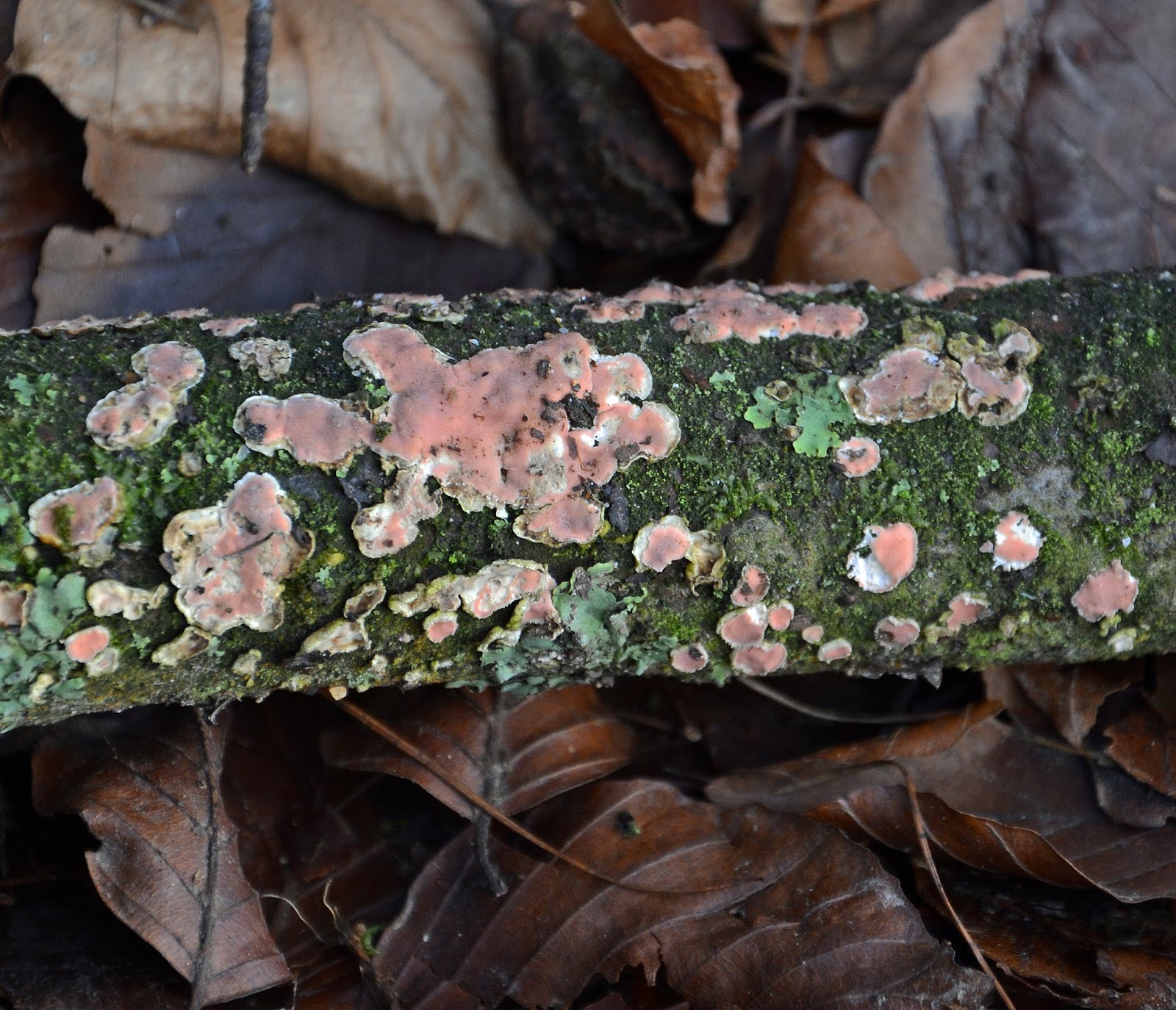
A little further on I came across a branch across the path, that had obviously been blown down from the tree above by the storms. Closer inspection revealed a series of pink blotches with a surround of white. Another rather gaudy fungus, with once again an excellent name - pink disco!


Pink Disco - a rather peculiarly coloured fungus to come across


Not to be outdone, the Lichen family wanted to show me that they too can add some colour to a miserable February day! This lichen looks as though it had originally been squeezed out of a toothpaste tube - it looks so fresh and minty! 


Phlyctis argena (I'm fairly sure that I have identified this correctly, although I'm no great expert on Lichens!)


So it just goes to show; look more closely and nature always has a delightfully colourful display for you - even on a dull, dull day.