Saturday, 19 December 2015

Book now for bird ID courses, so you don't miss out - as they are filling fast. We are counting on you!

What's that birdie? This lot know because they have attended a farmland bird ID course! 
Well, well, well! It is nearly time once again to dust those binoculars off and take part in the GWCT’s third “Big Farmland Bird Count”. Whether you took part last year or if it’s your first time, this is
your chance to see how numbers have changed or to find out what different species are around on your own farm, or indeed if you are not a farmer, then on a nearby farm (with permission of course!!).

Last year nearly a thousand farmers took part and recorded an amazing 127 species!  Farmers from every county in England participated and there were responses from Ireland, Scotland and Wales too. Very well done to the county of Norfolk as they had the most returns with 64 farmers completing the survey, closely followed by Yorkshire with 62. 

Yorkshire second – surely not! Now that has to be a challenge to those who farm in “God’s own country” – their words not mine!! (Norfolk farmers – don’t let them beat you this year as we will never hear the end of it!!). As for my own county of Hampshire – I have some chivvying to do – surely we can come top, both on the number of farmers counting and species recorded!

Guy Smith – well known farmer and NFU vice president says; “I often hear farmers grumble that while they are quietly proud of how much wildlife they have on their farms they get fed up with reports in the media that modern farming is bad for birds. I can understand the frustration but to my
mind the answer is, don't just be proud – be loud. So, come next February get the binoculars out, dust off the notepad, sharpen the pencil and get recording!”

So why am I shouting about the BFBC if it doesn't happen, as Guy says, until February? Well my little budding twitchers, I am giving you time to get some training in beforehand! No, not fitness training after Christmas's debauchery, but some preparation time before the big event, so that you can tell a Dunnock (little grey and brown job – LGBJ) from a Meadow Pipit (little brown job - LBJ).  

Yes, this is your chance to come on a farmland bird ID course before you go out to check up on what you have got on the farm. Let’s face it, some of these LBJ’s are just that and not a lot else, as they sit silently in a thorn bush or shuffle about in a stubble field.

But wait, this ID course will tell you all about the bird’s “Jizz” – a fabulous birding word that is used to describe what the bird does and how it behaves. How does it sit in that thorn bush – on its own or in a flock, in an upright way or horizontally, on top of the bush or skulking around at the base? How does it move about in the stubble field – does it hop, walk, shuffle or run!  

All these things help you slowly eliminate some birds and home in on others, eventually nailing the bird that you are looking at! Each course will also cover what different bird species need to over-winter successfully on your farm and give details of how you can help them do just that, by providing what they need. Indeed, once you know what species you have in your locality, then you can target your management directly at those birds.

So, how about signing up to one of these ID days that is happening near you – we have arranged 18 locations across the country, so there should be one not too far away. This will then enable you to strut, stride, skip or stomp, (depending on your personal jizz) around the farm for about half-an-hour, on one day between 6-14 February, with enormous confidence that you are noting down birds that you really have identified correctly with your newly learnt skills!

Finally, this year we have a superb new offer. Along with our very loyal sponsors BASF who enable us to hold these training days and the great BFBC event, if you complete all the relevant information and send your forms back to the GWCT, you will automatically be entered into a prize draw for a fantastic pair of SLC 8x42 binoculars, donated by Swarovski Optic. These are seriously good binoculars that will last you a lifetime.

Go on a training course AND win these superb binoculars and you will really have absolutely no excuse - any bird preening before you will prove to be an absolute walk in the park for you to ID!


To sign up to our Bird Identification Days being held in 18 locations across the country, or to download count forms, please visit: www.gwct.org.uk/BFBC or telephone: 01425 651000. 

Come on everyone - lets smash last year's totals!!


Sunday, 13 December 2015

Congratulations Paris. But now the real work starts.

Soil and water management; carrying on as we are currently, is not an option
So, with the bang of a gavel last Saturday evening, representatives of 195 nations reached a landmark accord that will, for the first time, commit nearly every country to lowering planet-warming greenhouse gas emissions to help stave off the most drastic effects of climate change. This is of course very encouraging news, however, only time will tell if collectively, humanity can deliver on this agreement.

Climate change is of course caused by a host of different reasons and is intricately linked to the way we manage and use the resources that the world offers us. If you just look at two such resources, soil and water, you can see that we need to change our ways big-time and rapidly.

A new report on soils published this month by the Sustainable Food Trust, is to put it bluntly, alarming. I have taken some extracts for you to read:

“Soil is a vital resource for the future of humanity. It needs to be protected and enhanced. Instead, more than half (52%) of all fertile, food-producing soils globally are now classified as degraded, many of them severely degraded (UNCCD 2015).

Throughout human history, at least twelve past civilisations have flowered on fertile soils and made huge advances, such as the development of written language, mathematics and financial systems, only to disappear over time as their soils progressively degraded and could no longer feed their populations.

These civilisations occupied, or depended on, defined geographical regions: the Sumerians in Mesopotamia, the Roman Empire’s exploitation of the once highly fertile soils of north Africa, parts of ancient Greece, China, Central America, India and elsewhere. The damage done to soils in these regions is still present today, but new civilisations were able to spring up elsewhere, converting forests and native grasslands to agriculture and thriving on the fertility that had built up over thousands of years in the soil.

Today, however, due to the global trade in food, the global adoption of exploitative farming methods and the extent to which forests and natural grasslands have already been converted to crop production, it is the entire global civilisation that is threatened by progressive soil degradation.

Research by the Economics of Land Degradation Initiative in 2015 calculated that soil degradation is costing between $6.3 and $10.6 trillion dollars per year globally, but these costs could be reduced by enhancing soil carbon stocks and adopting more sustainable farming methods.

A research group at Cranfield University estimated that in England and Wales soil degradation costs £1.33 billion annually. Half of this cost relates to loss of soil organic carbon (SOC), and the intensity of farming is a major cause of soil carbon loss.

Agriculture and the food we eat depend on soil. Under appropriate management soils are an infinitely renewable resource, while under inappropriate management they are effectively a very finite resource. Under natural conditions it can take 500 - 1,000 years to form an inch of soil from parent rock”. (I have highlighted this).

Here are a few statistics to ram the message home – if it really needs to be, any longer, that is. Recent estimates indicate that every year:
Soil degradation affects 1.9 billion hectares
12 million hectares (23 hectares a minute) of land is lost to food production
24 billion tonnes of fertile soil is irretrievably washed or blown away (3.4 tonnes for every human on the planet).

If you would like to read more from this report, go to:

Meanwhile, perhaps the most important world resource of all, water, is also causing major concerns.

Across the globe, reports reveal huge areas in crisis today as reservoirs and aquifers dry up. More than a billion individuals – one in seven people on the planet – now lack access to safe drinking water. The world faces a water crisis that will touch every part of the globe, a point that has been stressed by Jean Chrétien, former Canadian prime minister and co-chair of the InterAction Council. “The future political impact of water scarcity may be devastating,” he said. “Using water the way we have in the past simply will not sustain humanity in future.”

With expected increases in population, by 2030, food demand is predicted to increase by 50% (70% by 2050) (Bruinsma, 2009), while energy demand from hydropower and other renewable energy resources will rise by 60% (WWAP, 2009). These issues are interconnected – increasing agricultural output, for example, will substantially increase both water and energy consumption, leading to increased competition for water between water-using sectors.

The world runs on water. Clean, reliable water supplies are vital for industry, agriculture, and energy production. Every community and ecosystem on Earth depends on water for sanitation, hygiene, and daily survival.

Yet, around 700 million people in 43 countries suffer today from water scarcity.

By 2025, 1.8 billion people will be living in countries or regions with absolute water scarcity, and two-thirds of the world's population could be living under water stressed conditions. With the existing climate change scenario, almost half the world's population will be living in areas of high water stress by 2030, including between 75 million and 250 million people in Africa. In addition, water scarcity in some arid and semi-arid places will displace between 24 million and 700 million people.

So you can see that although the Paris agreement is all about “climate change” – if you lift off the lid and look in, it is in fact about so, so, much more. I have just highlighted two elements here. Let us all hope that it truly marks a monumental turning point in the way we treat the world’s resources, otherwise, the future really does not bear thinking about.


Thursday, 10 December 2015

Ramblings on Bramblings!

I think it going to be a good winter for spotting Bramblings, maybe even in your back garden! 

Last year, we had an enormous Beech tree mast supply in the UK – “mast” being the name of the Beech tree’s seed. Bramblings simply love this seed and large flocks will spend the winter foraging around under Beech trees, so accordingly they don’t really need to rely on our garden bird table hand-outs. I only occasionally saw a lone male visiting my garden last winter.

However, this year the Beech mast harvest has been quite small and already I have at least 6 Brambling visiting my garden on a daily basis.  So, what exactly does this bird look like, because to be honest, it could easily be over-looked and noted down as a common old Chaffinch!

Brambling are similar in size and shape to the chaffinch, and they do team up in the winter months with their close cousins, feeding together as a mixed flock. The noticeable difference is that the male has a dark head and appears to look like a rather “orangey” Chaffinch. The other clue to look out for is when they fly up and away from you, as they have a bright, really strikingly obvious white rump patch, so keep a good look out for this.

Bramblings are winter visitors to this country, as they breed in Scandinavia and Western Siberia. They come to our shores to escape the harsh continental winter, and turn up in particularly big numbers here, when snow and lack of food forces them to venture across the North Sea.

They particularly like to feed on the ground, but will also perch on feeders to eat various small seeds. They love sunflower seeds – in or out of their husks!! So I chuck some mixed corn and a few sunflower seeds onto the ground each morning and they fly down and are pecking around before I am even back in the house! 
   
To help you know what you are looking out for, I have put up a picture of both the Chaffinch and Brambling – so keep an eye open for them and do let me know if you a lucky enough to get a visit from this great little finch in your garden.


The "orangey" male Brambling

The much more "pinky" male Chaffinch

Sunday, 29 November 2015

The new Agricology website is launched - for everyone to use!


From left: Dr. Alistair Leake, GWCT's Allerton project; Dr Susanne Padel, Organic Research Centre; Sonia Phippard, Director General of Policy at Defra; Patrick Holden, representing the Soil Association. 
I get invited to quite a number of work related events, but invariably I turn to the relevant page in the diary, only to find that once again I already have a commitment for that day. So it was a pleasant surprise when an invitation to attend the launch of a new website, “www.agricology.co.uk” for Friday the 27th of November, was shock horror, FREE! 

I was quite well briefed on this new initiative as GWCT colleague, Alistair Leake, (Alistair heads up the GWCT’s farm at the Allerton project, Loddington, Leicestershire) has been a one of the key players in getting this initiative off of the ground and I have also supplied a few photographs for the new website.

More than seventy people attended the launch, which was held at the wonderful Daylesford organic farm near Kingham in Gloucestershire, by kind permission of Carole Bamford. I must say that the staff from the centre made everyone extremely welcome and provided us with a delicious lunch too!

So what exactly is “Agricology”?

Well, it is a collaboration of independent organisations and farmers that provide practical and knowledge-based information about sustainable farming. It promotes sustainable farming regardless of labels and encourages good agricultural practices by using the best ideas from organic farming and integrated conventional farming. The aim of this new website is to bring together information and knowledge to help secure a productive, resilient and sustainable future for agriculture and the farmed environment.

The three key players that have come together to create this exciting new initiative are, the Daylesford foundation, the Allerton Trust and the Organic Research Centre at Elm farm. But importantly they have a wide range of support from across the industry, from organisations such as NIAB, Rothamsted research, LEAF, FWAG, Natural England and DEFRA, just to mention but a few.

Following a welcome from the host, Carol Bamford, there were three really excellent talks, indeed dare I say it - refreshingly so!

Patrick Holden, the well-known supporter of organic farming, told the audience how important it is that all sectors of agriculture work closely together and share their collective knowledge. Indeed, he was humble enough to say that perhaps in the past, there were times when the organic movement had not communicated well with other forms of farming and maybe vice-versa. 

Alistair Leake spoke eloquently about the importance of research and how sharing and accessing practically based science, is so absolutely key to both the success of sustainable farming and the environment as a whole.

Finally, Sonia Phippard, Director General of Policy at Defra, gave her fulsome support to the initiative and seemed really delighted that she could be there to say how important she thought the Agricology initiative is going to be, in delivering practical information for sustainable farming going forward. 

Before leaving the event, a number of people were giving a tour around the Daylesford dairy enterprise by Richard Smith, the senior farms manager. Listening to Richard talk so passionately about his dairy cows, made me begin to see why these people and their associated organisations have fitted so well together and launched this new website.

They all truly believe that profitable, sustainable farming and a thriving healthy environment can go hand in hand. However, to achieve this, ALL forms of agriculture must work closely together, using the very best, up-to-date practical science.

I for one, fully endorse this and hope that you too will take time to look at the new Agricology website, following it over the coming months as it becomes more and more populated with world-class examples, taken from a range of applied and academic sources and of course, from the practitioners themselves – the farmers!


A few more photos of the launch event:

Alistair Leake spoke of the importance of practically based research


Sonia Phippard was very enthusiastic about Agricology


Delegates thoroughly enjoyed looking around the dairy unit

Richard Smith's enthusiasm was a typical trait of the day!  


Saturday, 21 November 2015

The incident of the woodpecker and sheep's wool, a ladder and scissors!

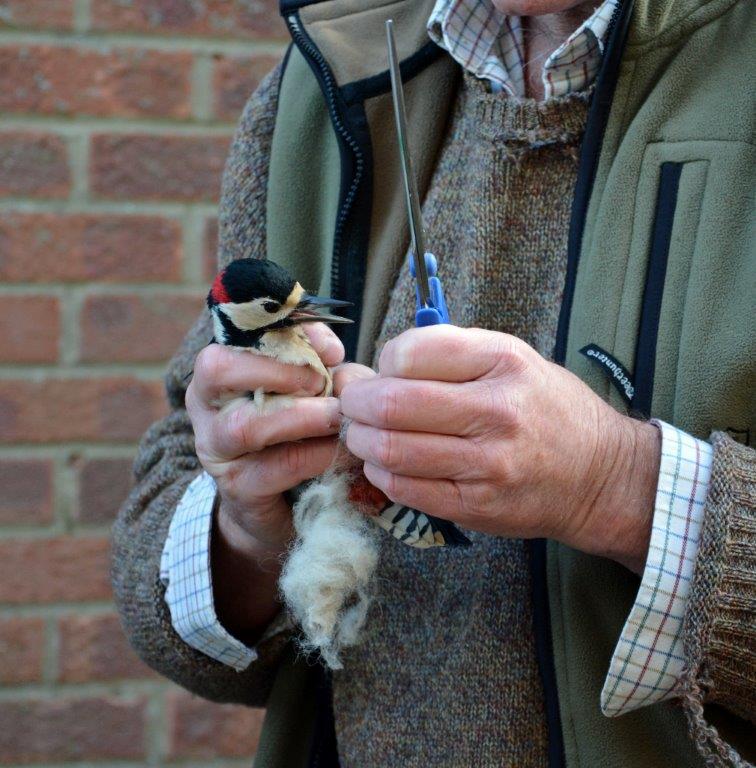
The Sheep's wool was well and truly tangled around the unfortunate bird's legs. The small red patch on the back of the head tells you that this is a male bird, as the female lacks this.
 Once you have lived in a village for a good while – 25 years in my case – a number of local folk get to know you and also what you particular passion is. We are blessed with experts on UK local breweries, old planes, vintage cars, metal detecting, botany and countless other interests! A visit to the Flower Pots pub will without fail teach you a little something, even if it is only that you cannot down as many pints as you used to, without feeling a little jaded the next day!

Over the years, helped along by writing a little wildlife piece in the parish magazine each month, people have learnt about my passion for “all things countryside”, and so come up to me to tell me of their sightings and snippets of interest, which is wonderful as it keeps me informed with what is happening locally. They also send me an array of varying quality photos of thing to be identified! A Chinese painted Quail pecking around under someone’s bird table, is the best so far I think!

So I was not that surprised when the phone rang this morning and good friend Annie Bishop started off by saying “hi Pete – this is going to be one of the stranger calls you will receive today!” She went on to tell me that a black and white woodpecker was hanging up-side-down from a nest box on the neighbour’s house, held tightly by a thick strand of sheep wool!

“I’ll come round, get the ladder out and a pair of scissors!”

Well to cut a long story short, we managed to cut the unfortunate male Great-spotted woodpecker free and take it into the kitchen, were Greg, Annie’s husband discovered that he could easily have been a Vet rather than a Maths teacher! He very carefully and expertly snipped away at the entwined mass of wool that was well and truly wrapped around both feet, while I held the bird and stoically took the frequent sharp jabs from the indignant bird’s extremely sharp beak!

The lady who lives next door, loves the wildlife that visits her garden, so she not only feeds them assorted food, but also puts out a large hanger full of wool for birds to gather when making their nests. Obviously quite a lot of this had found its way into the nest box, high up on the wall. I expect this particular inquisitive guy had explored the box to find spiders and hibernating insects and in the process had got himself in a bit of a tangle – literally!

The neighbour was of course mortified that this had happened and was incredibly grateful that Annie had spotted the unfortunate bird, as it would surely have died a miserable death if she had not been so eagle eyed while putting on the kettle for the early morning cuppa.

Eventually, after a good quarter of an hour or so, the bird’s feet were free and so we took it out into the garden to set it free once more. It just happened to be Annie’s birthday and she declared that to see this beautiful woodpecker fly away unharmed, had been a really great present.

Meanwhile the neighbour set off with a purposeful stride to take down the wool container and clear out the nest box!

It might be an idea to cut the wool into very short lengths if any of you intend to do this in future, rather than long strands, as it is incredible tough stuff to pull apart.
  
  
Back to normal and ready for release after the attentions of  "Greg the Vet"! The red patch is not a blood stain - all Great-spotted woodpeckers have this red patch under the tail. 

Monday, 16 November 2015

The farmland around the village of Selborne was alive with action this weekend!

The Selborne Landscape Partnership group - ready for for either hedge laying or Harvest mouse nest hunting!

The Selborne Landscape Partnership – a group of farmers based around the Hampshire community of Selborne was in action over the weekend!

You may well have heard of this village, as it was put firmly on the map because many, many moons ago the famous naturalist, Gilbert White, was born here and eventually wrote his book in 1789 “The Natural History of Selborne”, which chronicled the local wildlife and day to day life of this picturesque part of England.

This group of farmers has come together to see if they can collectively manage the land that surrounds Selborne in a more “joined up way”. This particular weekend was a chance for local farmers and volunteers to come and learn all about the old tradition of “hedge-laying”.

Rob Nicholls, a countryside Ranger with the South Downs National Park in conjunction with farmer, Kate Faulkner, did a superb job of arranging the event by bringing in an expert tutor, laying on lunch and of course providing a suitable hedge! 

An enthusiastic assortment of folk turned up to learn this fine art and I think you will agree that the finished article is something to be mightily proud of!

Meanwhile, another group had also turned up to hunt for Harvest mouse nests around Kate’s farm as we are keen to learn more about this tiny mammal and find out how its population might have changed since Gilbert White’s day. The volunteers had a briefing in the barn, before setting off to hunt the field margins to see what they could find.

This is just one of a number of days nest hunting that will be organised over the next few weeks and I will let you know through this Blog how they all got on!

It was wonderful to see so much activity on the farm. I'm sure this is a group that is going places and I will make sure that you are the first to hear about future happenings!

Here are a few more photos of the action!   


Harvest mouse briefing in progress


The hunt in progress!

Meanwhile - elsewhere on the farm

All starting to look good!

The finished article - what a superb job!