Showing posts with label Moths. Show all posts

Sunday, 6 October 2013

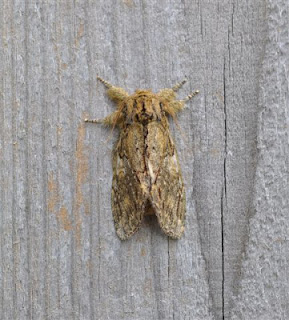
A Dewick's Plusia - what on earth is that!

A Dewick's Plusia moth
I caught this little beauty for the first time ever yesterday, with its punk hair-do and splash of white on its side  –  it is called a “Dewick’s Plusia” and is a vagrant to Britain, mainly being caught along the south and east coasts. August is the optimum month for this species, but records have occurred between July and October and it seems to be appearing more and more frequently on our shores.
 
It is named after AJ Dewick who trapped moths in Essex and caught the first one in the UK at Bradwell-on-Sea, Essex, in October 1951. Plusia is a genus of moths of the Noctuidae family. How great to have a moth named after you!
The first one seen in Hampshire (where I live) was caught in 1991, however, nowadays a few are caught each year – but not many - it’s a first for me!


Tuesday, 3 September 2013

Very small, pink and nationally scarce!

Cochylis flaviciliana 
I caught a very pretty little (and by little I mean a wingspan of 11-12 mm!) moth in the moth trap the other night and thought it might be quite an uncommon one, so I e-mailed a photo to Mike Wall, a brilliant local specialist of so called “micro” moths and after a couple of days he confirmed that it is a “nationally scarce” little beastie – in fact it appears that this is only the fourth to be caught in Hampshire (where I live) since 1990 and the first since 2002!
 
I must say that it is great to have Mike on hand to help with the ID of some of these little critters – he runs an excellent website called Hantsmoths which helps me to ID most, but if not he is always most willing to cast his expert eye and give you a name. This little beauty goes by the name of Cochylis flaviciliana and the caterpillars are so tiny that they actually feed INSIDE the seeds of field scabious!

For me, yet another amazing discovery, plucked out of this fascinating world and caught in my garden – can’t be bad!  In case you are wondering – all the moths I catch are released the next morning – unharmed!!  

Friday, 16 August 2013

Clever moths with balls!

Cechenena lineosa - a clever moth!
Bats and moths have been engaged in a natural arms race for nearly 65 million years, each evolving strategies to outwit the other. Scientists have long known that members of the tiger moth family blast bats with ultrasound signals, resembling the echolocation calls bats make as they search for and close in on prey. But tiger moths were assumed to be the only moth group able to imitate the bats' signals.
But now a study has shown that several species of tropical hawkmoths can rasp their genitals against their abdomens to beam out loud ultrasound signals at approaching bats, possibly as a weapon used to throw the hunters off course.
Behavioural ecologist Jesse Barber of Boise State University in Idaho and phylogeneticist Akito Kawahara of the University of Florida in Gainesville went to Borneo to try their luck with hawkmoths, a large family of excellent flyers, many of which are found in the tropics.
When the researchers played bat ultrasound to the hawkmoths, they found that three species (Cechenena lineosa, Theretra boisduvalii and Theretra nessus) that they had captured emitted ultrasound clicks in response.
The purpose of this behaviour is not known. It is thought that the moths' ultrasound perhaps serves as a boastful warning to bats of the hawkmoths' barbed legs and excellent aerial skills. One the other hand, it maybe that the hawkmoths are jamming the bats' sonar, as one species of tiger moth has already been shown to do. Either way, the fact that hawkmoths can also make ultrasound clicks means it is likely that "there are even more insect groups that make sounds back at bats", Barber claimed.

Monday, 15 July 2013

Children hold Elephants, Leopards and Tigers!


A close up experience with big moths!

The moth trap was in full swing over the weekend and catches were good, with lots of large Hawkmoths and other brightly coloured moths caught, so I kept some in captivity for a while as I had family, including young great nephews coming for Sunday lunch. There were Elephant and Poplar Hawkmoths, Leopard and Tiger moths to show off.
These larger moths are a wonderful way of engaging children (and adults!) who are amazed at the size and colour of some of these big moths, which also tend to be wonderfully behaved and just sit peacefully on a hand, allowing close scrutiny – perfect for that close up experience.
You never know, one of these guys might just have “caught the bug” as I did many moons ago and follow me in a lifelong fascination of wildlife – perhaps triggered by a short encounter with a colourful moth on a hot July day in Hampshire!
      
Elephant Hawkmoth

A Garden Tiger moth


A Leopard moth

Saturday, 13 July 2013

Beware - we are being invaded by rednecks!

Yes, it does sound as if we are being invaded by hillbilly servant  types from the American south – incidentally called “Rednecks” because the men who work in the fields generally have the skin on the back of their necks burnt red by the sun – but in fact I am referring to a moth! The common name footman comes from a supposed resemblance to the uniform of such a servant, but you need to use your imagination if you are to see this link I reckon.
The Red-necked footman is a resident moth, however its numbers can be boosted by immigrant moths crossing the channel, and I suspect that is what is happening right now during this hot spell we are all enjoying. I have caught 3 of these distinctive moths in the last few weeks and yet I have previously only ever caught 3 in total! The Footman family of moths is comprised of around 17 or so members in this country and are of particular interest in that most of the caterpillars feed on Lichens or green algae growing on trees.
Many people are amazed when I tell them that loads of different moths and butterflies cross over the channel – some species originating from as far away as northern Africa! I have already seen a Humming bird Hawkmoth and lots of Silver Y this year which have arrived here recently from overseas.
So, keep a good eye open over the next few weeks and see if you can spot any of these “invaders”!     
 
Silver Y moth - which you can see on it's side!

A Humming bird hawkmoth

Red-necked footman 

Monday, 20 May 2013

The curious art of the "Moth trapper"!

A Great Prominent
As we finally seem to have some slightly warmer night temperatures at present, I decided to run the moth trap over the weekend, to see what was about in my garden. So far this year I have only put it out a couple of times and catches were poor, with very few moths caught. Other “Mothers” also seem to have emerged from the long winter too, as the local “Moth chat site” has started to splutter into action, with reports of improved catches.
Whenever moth trapping happens to come up in a conversation – maybe because people have heard that there is this strange guy in their midst, you nearly always get the same reaction - “you do what – trap moths?! This is often followed by “aren’t they all brown and rather boring?” My answer is quite well practised now as I tell them that in fact many moths are really beautiful and that there are around 2,400+ to choose from in Britain, whereas only about 58 butterfly species are found here! I usually add that I catch them in a specially designed light trap, record them, sometimes photograph them and then let them go un-harmed.
If you can ever get these “doubting Thomas’s” along to look at the morning contents of a trap that has run over-night, they are often spectacularly surprised. Children too, absolutely love to peer at the catch and it is wonderful to watch their faces as they marvel at a large, brightly coloured Hawkmoth perched on their hand!
As for this weekend’s catch, well I got 15 different species including two “Prominents” - a Great Prominent and a Lesser Swallow Prominent. I will up-date you on future interesting catches as the summer progresses!