Tuesday, 7 January 2020

Catch 22

Just before Christmas this little chap - a male Sparrowhawk - started rushing through the garden, causing chaos and fear amongst the other garden birds. You can tell that this is a male as he is much smaller than the female and has quite a rich rufous coloured barring on his breast, whereas the female has a much greyer colour to the barring.

To begin with I only saw him occasionally, perhaps once every three days or so. But then he got lucky and managed to catch himself a blue tit, which he plucked and ate while sitting in the same little apple tree as in this picture. Now, he reckons our garden is a good bet for a scoff, so he is visiting us two or three times a day!! (I suspect he goes around all the bird tables in the village!)


A Sparrowhawk - such an amazing hunter!
Now here is the dilemma. I feed my garden birds from November until at least the end of April - even longer if it is a late spring. By mid-winter, I have built up plenty of regular visitors, covering a wide array of species, which in turn of course, attracts my "little Exocet missile friend!"

People often say to me "we have a bloody Sparrowhawk taking birds from our garden - what can we do about it?" My reply usually follows the lines of "well, firstly enjoy him or her coming to your garden as they are stunning birds!" This does not always endear me to people, as they are quite understandably fairly protective of "their" lovely little garden birds!

So, I go on to suggest that they feed the birds near to "escape cover" in the form of a thick hedge, bush or tree, so that when some bird raises an alarm call, they can all dash for cover! I say, "when a bird raises an alarm call", because most attempts by Sparrowhawks to catch their next meal, are thwarted by a shout of "danger". Most small birds will react to any other species alarm call, not just their own species.
 
This brings me to the safety in numbers policy. If I have twenty birds feeding in the garden at any given time - that is forty eyes looking out for danger. If I am a bird feeding on my own, I have just the two eyes and these also need to look for food at the same time! So, this same scenario is why many species gather together in flocks over-winter, as a predator avoidance policy.

Therefore, by feeding birds, I am attracting lots of them to my garden, which in turn attracts regular visits from the Sparrowhawk. But are they safer in my Michelin star restaurant garden, or in another "non-fed" garden elsewhere in the village? You, like the birds, will have to decide!


Wednesday, 1 January 2020

Remembering, but also looking forward

Happy New Year! 
I am restarting my blog once more, and intend writing quite frequently over the coming year - so check it out now and again! I hope you enjoy it! Do also get back to me with your thoughts, as I am always interested to hear from you! 

A friend in New York sent me these photos of a pigeon taking poppies from the Tomb of the Unknown Soldier War Memorial in Canberra, Australia. What on earth was it doing with them?  
Well, it turned out that this pigeon was in the process of building one of the most beautiful, yet rather poignant nests ever built! Not just the choice of nesting material was extraordinary, but the positioning of the nest was amazing too, as you can see below, it was right beside a stained glass window.
The poppy of course represents the remembrance of those who have fallen in conflicts from around the world, chosen because this plant sprang up across the churned up battle fields, turning them into a blaze of red. The poppy seeds had been lying dormant under ground, waiting for something to disturb the soil above. Tragically, this time it was the horror of war that gave them the opportunity that they had been waiting for, to spring into life once again.
This pigeon I feel, also reminds us that after death, new lives will spring forth. These poppies represented those who are no longer with us, but they then went on to support a new beginning as well, cradling the pure white eggs that this pigeon will lay.
Rather wonderful I think!


Wednesday, 3 January 2018

The special one!


Not everything in life turns out as expected.

Hatching out as a white baby Blackbird does your chances of survival no good at all. Any self respecting predator will spot you a mile away. 

But survive this "Whitebird" has, not just for a short while, but he is now into his second winter. Last summer he successfully paired up and raised young of his own - all of which turned out in a New Zealand coloured "all black" attire! 

You might expect old Whitey to be picked on by the other Blackbirds - but by all accounts he rules the roost in these parts - that is the two gardens and a small bit of woodland at the other end of the Wiltshire village in which I live.

In fact I am amazed by how small a territory he uses - it cannot be much larger than a couple of acres.

He has quite rightly become a bit of a celeb in these parts and good luck to him. Along with a certain football manager - I think he believes that he is definitely "the special one"! 


You want a photo?  Ok - I'll just turn my head a little. How's that look?


Frost helps - but if it snowed, then I could relax a little!

Do you like my feet - cool aren't they!

Wednesday, 20 July 2016

A wildly exciting day at Knepp Castle


GWCT staff on a visit to the Knepp Castle estate


Sometimes, just sometimes, everything falls into place and you experience a day to remember. 

Yesterday, a group of around fourteen Game & Wildlife Trust Staff visited the 1,400 hectare (3,500 acre) Knepp Castle estate in West Sussex, on a glorious high summer day.

Up until about 15 years ago, the estate was run in your bog standard way – you know the sort of thing – Wheat, Oil seed rape and a Maize crop grown for the dairy herd. Then Sir Charles Burrell (very much “Charlie” to everyone!) decided that enough was enough and that he could not continue to run the estate as it was, with the stresses and strains of large overdrafts, resulting in poor returns.

Charlie took the radical step of pulling out all the internal fences and, over a period of a few years, turning most of the estate into the UK’s largest lowland rewilding project. Now, this does not mean pulling the plug on all management and allowing nature to take its course, well not entirely anyway.

The project is interested in trying to “recreate” the wildwood of ancient Britain, but in today’s world. He has introduced Longhorn cattle, Tamworth pigs, Exmoor ponies, Red & Fallow deer which munch, browse, strip and root about in the growing vegetation. In effect, they represent the large prehistoric herbivores that would have existed way back in time, which created a mosaic of habitats from open pasture, through scrub, right up to closed canopy woodland – and everything in between! 

What is really interesting to me is that the estate’s finances now look in good order; but how can that be? Well, the pork, beef and venison which is raised in such an extensive and natural way from across the estate commands a decent premium. Many of the buildings that used to house stock, have since been converted into small business units, making a regular monthly income.

Another venture has brought the public onto the estate, who not only can go on “wildlife safaris” to see and learn about the wildlife and varied habitats, but also potentially to stay on site in a variety of luxurious bell tents and shepherd’s huts. Add to these estate businesses, the money from both the Common Agricultural Policy and Stewardship schemes and you begin to see how it all comes together.

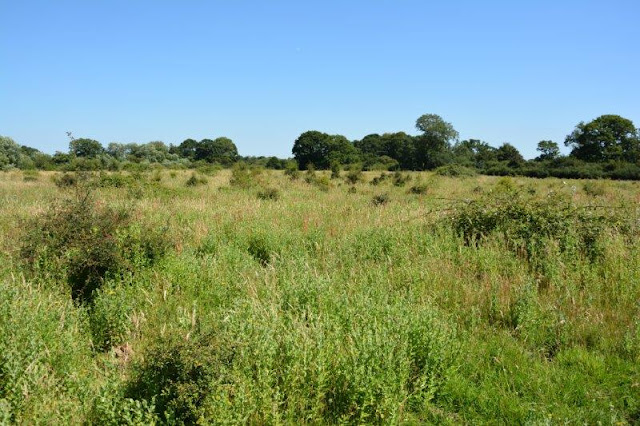
I found the mosaic of different habitats amazing. I expected to see a more uniform scrubby/woodland scene, but the animals are certainly having a major impact on the end result. You can see from the few photos that I have put up, everything from young, thick, shaded woodland to grass fields which look as though they are cut for hay each year! 

Even arable plants survive. One might well think that this would be a group of plants that would suffer once the cultivators have been sold. But now the pigs do the “ploughing”, leaving churned up areas that quickly fill with a community of these plants such as Scarlet pimpernel and the rarer Sharped-leaved Fluellen.

We stopped at a good spot for viewing the wonderful Purple Emperor butterfly and almost immediately saw some flitting at speed around the tops of their favourite oak trees. The resurgence in young sallow – their caterpillar food plant – seems to be helping numbers increase. Penny Green, the estate ecologist, had found a young caterpillar which she followed through to the chrysalis stage and eventually, successfully hatching out into an adult. The photo of the empty pupal case is pictured and it was great to think that we were probably watching the original occupant high up in the canopy!
      
Finally, we landed back at the Charlie’s wonderful home, where his wife Isabella had prepared us all a superb summer lunch. As you might well imagine, with a table surrounded by scientists, conservationists and land managers – the discussion was robust and wide ranging!!

This is a fascinating project and I hope that it continues for many, many years to come as it is helping to reshape much of our thinking about the countryside and how it is managed. I would very much like to thank Charlie, Isabella and Penny for imparting their knowledge so freely, coupled with their infectious enthusiasm and wonderful hospitality. Here are some pictures of the visit:

Charlie Burrell


Track through open scrub land

Vegetation varied widely

Enclosures to exclude animals shows how effective they can be in controlling growth


Tamworth family doing what pigs do!

Pig cultivation

Arable flowers survive because of the pig cultivation - here Scarlet Pimpernel 


Here thick young woodland has got away from the herbivores

This scrape was created, but the surrounding sallow is entirely natural


Exmoor ponies enjoy "meadow" grazing


Empty Purple Emperor pupal case  

What a wonderful way to round off a superb visit!

If you would like to find out more, then go to: http://www.knepp.co.uk/    


Friday, 8 July 2016

Silver Lapwing flies from Sussex to Wales!

Annie Brown left (2015 winner) hands over the prestigious Silver Lapwing award  to Richard and Helen Roderick
I attended the 39th Silver Lapwing awards yesterday, organised by the Farming & Wildlife Advisory Group (FWAG) and kindly sponsored by Waitrose. Heather Jenkins, Waitrose Director of Buying, attends the awards each year and told the audience how much importance the company places on these awards.
 
The event was held at Annie Brown’s stunning farm, high up on the Sussex Downs, with distant views overlooking Shoreham-by-sea, while passing container ships far out on the ocean completed the backdrop.

Annie was deservedly the winner of this prestigious award in 2015, as she and her team have over-seen a remarkable transformation of this part of the South Downs. Ironically, the whole farm was put into grass under the “Environmentally Sensitive Area Scheme” as conservationists at the time thought that this was the right thing to do with the Downs (severely criticised by the GWCT at the time I hasten to add!).

In 2007, Annie took over the running of the farm following her father’s death and she realised that the grassland was not delivering any sensible grazing nor any environmental benefits either. Indeed, the wildlife had exited the farm big time, as species such as Corn Bunting and Brown Hare disliked the mono-culture of grass.

As Annie says “The excitement as the plough transformed some tired grassland on the Downs was palpable, and the fact that the Corn Bunting returned to the farm so quickly shows just how resilient nature can be”.
    
After a delicious lunch of local lamb and an assortment of fresh Waitrose produce, we all jumped on trailers to take a look around the farm. I have known this farm for some time, but WOW – it is a long time since I have heard this number of Corn Bunting singing! Every time the tractors pulled over and engines were turned off, there was a constant background of “rattling keys”, the song of one of the UK’s fastest declining farmland bird species.

Skylarks, Meadow pipit and even a couple of calling Quail added to the wonderful cacophony of sound. Meanwhile, many rare arable plants such as Night-flowering catchfly and Prickly poppy have come back in profusion, having patiently waited under grassland for this opportunity – colourfully reminding us all that the Downs were indeed one of the first parts of this country to be cultivated by our distant ancestors!

So what exactly has Annie and her team done to bring a silent grassland farm back from the dead? Well, she has taken good advice from a range of people and is also very lucky to have a top Natural England advisor in the form of Sue Simpson to oversee her Stewardship agreement. She has also created a hard working farm team around her, who are as dedicated and enthusiastic as she is. How often do I find myself saying this after visiting top award winning farms!

She has introduced Beetle banks, wildflower margins, wild bird seed mixes, fallow plots and also carries out supplementary feeding in the depths of winter, amongst many other things. The arable cropping is not in huge blocks of the same crop type, but broken up, and of course she has still retained plenty of downland grass, which intersperses the arable. What is more, the grass is grazed by both cattle and sheep.

I did say on the way around the farm that should I be re-incarnated as a Corn Bunting – then please may it be on this farm!!

So, who has won this year’s award? Well, a charming couple called Richard & Helen Roderick, from Newton farm, Scethrog, who manage a mixed farm of 650 acres in the Usk valley near Brecon in Wales. They were obviously absolutely delighted and I would like to pass on my congratulations to them, as it is no mean feat to win this prestigious, national award. 

I would also like to congratulate Dominic Gardener from Lee farm, Angmering in West Sussex for coming second in the competition. I know Dominic well and can vouch for just how dedicated he is to farming with wildlife in mind.

I greatly look forward (if invited of course!) to looking around the Roderick’s farm next year in the knowledge that it has to be one hell of a place to have picked up the 2016 Silver Lapwing award!

After a delicious lunch, everyone thoroughly enjoyed looking around Annie's beautiful farm


Sunday, 5 June 2016

Keep an eye on your Brassicas - lots of Diamond Geezers about!

A tiny Diamond-back moth - only around 7 or 8 mm long! 
On Saturday night I set my moth trap out in the garden, as the night looked set to be warm and still - not something we have experienced much of lately.

In the morning I was amazed to find the outside of the trap covered in little Diamond-back moths! On opening the trap, clouds of the tiny creatures flew out and the egg cartons (where the moths hide in the trap) were covered with yet more.

By the time I had finished examining the catch - a rough guesstimate was that I had caught around a 1000 of these little migrant moths.

Despite their minute size these micro moths travel to our shores from the continent and then have several broods during the summer. It is quite normal to have catches of double figures in the late summer - but a 1000 moths so early in the year is incredible.

The reason I have titled this blog so, is that the food plant of Diamond-back larvae is brassicas of all sorts. So you gardeners and commercial veg growers beware - we are being invaded big time!