Wednesday, 24 February 2021

Fake Tesco farms


I was reading a marketing training guide the other day and it said “Customers expect brands to be open, honest and authentic. They are increasingly interested in understanding provenance and are much more marketing-savvy than they used to be. Brands must be as clear as they can be, to avoid confusing customers in any way”.

Well, I do not think that anyone from Tesco’s marketing department has been on this course or indeed, any other marketing course.

Actually, having had second thoughts about this, quite possibly I’m wrong and they have all been sent on a training programme entitled “How to be as economical with the truth as possible”.

Tesco’s you see, have a range of branded farms with quintessentially rural sounding British names, such as Nightingale farms, Willow farms, Woodside farms and Redmere farms. Oh, that’s nice – supporting British farmers.

But you really don’t have to dig that deep to find out that these farms are completely 'fictional' farm brands. Yep – these farms do not actually exist.

Let me give you an example. Below is a photo of a label from a packet of Tesco Garlic from Redmere farms. Turn it over however, and you will see that it has been sourced from China!


Now, is this a little “un-truth”, a fib or a full-blown lie. Well, I am not certain – but it sure as hell is not squeaky clean is it?   

The other thing that Tesco has started to use is the phrase “Trusted farms”. This term means what? Trusted to be cheap as chips? Trusted to keep shelves full, whatever the cost to the animal?  It certainly does not have any legal definition when applied to animal welfare.

The ham joint in the photograph does not even have a country of origin written on it. But that’s OK folks, because after all, it is from a trusted farm.


I will leave you to make up your own mind about this marketing ploy. But I just want you and Tesco to know, that I most certainly did not buy either the ham or the garlic.


Wednesday, 10 February 2021

Wasps are amazing!


Last year I saw that I had wasps going in and out of a brick air vent in the front of my house. I always leave wasps nests alone if they are not bothering anyone, and apart from avoiding the use of a short cut through path, this nest was not an issue.

I have now removed the unused, old nest as it was obviously blocking up the air vent. As you can see from the photo, it is a good size and rather elongated instead of round, as it had to be built to fit along the channel within the house.

Wasp's nest with tennis ball for size comparison

The inside of the wasp's nest


I recovered a couple of dead wasps from the nest and identified them as Vespula vulgaris, the common wasp.

The queens which were born last year, are the only survivors from the nest and having mated, will now be hibernating over-winter somewhere away from the nest.

When the queen emerges from hibernation in the early spring. She establishes her nest usually in a cavity in the ground or a tree, and as she builds each cell, she lays an egg in it.

After about 30 days, her first offspring, which will be workers, emerge as adults. These will all be female wasps and they will take over the foraging, nest building and maintenance duties, while also tending to new broods. Meanwhile, this extra help allows the queen to concentrate on laying egg after egg.

I watched many of these workers chomping away on my wooden fence throughout the summer, taking away small amounts of wood which they then chew into a paste-like pulp mixed with their saliva. They then form this pulp into the outer wall and also into hexagon-shaped paper cells within. The whole nest resembles a structure made from delicate sort of paper-mache.

From these new broods will hatch carnivorous larvae, which the adult wasps will bring food to in the form of aphids and other insects. In return, the larvae excrete a sugary liquid for the workers to eat.

The single queen who resided in my nest could have produced up to 10,000 workers, who in turn potentially may have gathered up to 250,000 aphids or equivalent!

Wasps are also pollinators of flowers and crops. Adult wasps don’t need much protein (the bugs they prey on are for the developing brood in the nest) but they do need sugar, which they get in the form of nectar from flowers. In the process of finding it, wasps pick up and transfer pollen from flower to flower. Unlike many bees, wasps do not mind what flowers they visit – as generalist pollinators they are often more abundant than bees in degraded or fragmented habitats and so are important ‘back-up’ pollinators in these areas.

Once the colony is big enough, the queen will switch to laying a sexual brood - these are males and the sexual females capable of becoming next year’s queens. When the sexual brood emerges, they leave the nest to mate and then the queens will find somewhere to hibernate over the winter.

So, should you find a wasps nest somewhere that is not going to cause you any immediate problems, then leave them be, as they are both fascinating and useful creatures!  

Tuesday, 2 February 2021

BP’s “dirty little secret”


Bernard Looney became BP’s boss about a year ago and one of the first things he did was to commit the company to a net zero carbon footprint by 2050 or sooner. Quite a statement for such a company to make. Obviously to achieve this, there will have to be some very difficult decisions to make, including potentially getting rid of a number of investments which may be “hard to swallow” for shareholders of the company.

Let me tell you about one such investment.

BP have a 20% holding in a state controlled Russian company called Rosneft. This company is undertaking one of the biggest oil projects in history. So what, that is surely what BP do – invest in oil amongst other things.

Yep, but why does the company include the money earned from this project in its annual financial performance, which is out this week, but fails to include Rosneft’s emissions in its climate aims?  

I wonder if this huge project based in the pristine, northernmost tip of the Siberian Artic, is just too lucrative to bail out of yet, despite its dirty black, rather than green credentials?  

Now, when I say that this is a huge project, by George, I mean huge!

The project, whose committee is chaired by former German chancellor Gerhard Schroder, is worth $134 billion and has required two new airports, a new port, a 480-mile-long pipeline and 15 new towns to support the 400,000 workers.

This raises the concern that BP’s ambitions to cut their carbon footprint, only covers their own output, not Rosneft’s or oil that is traded.

Rosneft pumped out about 2.1 billion barrels of oil and gas in 2019, putting BP’s share at more than 400 million barrels. You might begin to see why they are reluctant to cut themselves free from such a lucrative business.

I am not the only one asking if BP’s statement of “net zero by 2050 or sooner” simply means that they have three decades to make a decision on Rosneft?  


Wednesday, 13 January 2021

You should be itching to know about this….


Researchers at the University of Sussex have found widespread contamination of English rivers with two neurotoxic pesticides commonly used in veterinary flea products: fipronil and the neonicotinoid imidacloprid. The concentrations found often far exceeded accepted safe limits.

Rosemary Perkins from the University of Sussex analysed data gathered by the Environment Agency in English waterways between 2016-18. They found that fipronil was detected in 98% of freshwater samples, and imidacloprid in 66%.

Rosemary Perkins, a PhD student at Sussex and a qualified vet, said: "The use of pet parasite products has increased over the years, with millions of dogs and cats now being routinely treated multiple times per year."

So why might this be an issue? Well, for starters these products have been banned across Europe for use on farms, because of their potential impact on pollinators. (although recently it has been allowed again in some countries, including England, for Sugar Beet production).

If you take a look at the advisory label on fipronil, it states that it is highly, to very highly toxic to marine and freshwater fish and that it is also highly toxic to freshwater invertebrates. This, coupled with the fact that they are widely toxic to most land based insects too, shows us that they are potentially a considerable problem, even at very low levels.

Dave Goulson, Professor of Biology at the University of Sussex, who specializes in the ecology and conservation of insects, states that the Seresto dog collar contains 4.5g of imidacloprid, enough Neonicotinoid to kill 1 billion honeybees.

According to the Veterinary Medicines Directorate who funded the research, there are 66 licensed veterinary products containing fipronil in the UK, and 21 containing imidacloprid, either alone or in combination with other parasiticides. These include spot-on solutions, topical sprays and collars impregnated with the active ingredient.

The paper, published in Science of the Total Environment, notes that the highest levels of pollution were found immediately downstream of wastewater treatment works, supporting the hypothesis that significant quantities of pesticide may be passing from treated pets to the environment via household drains.

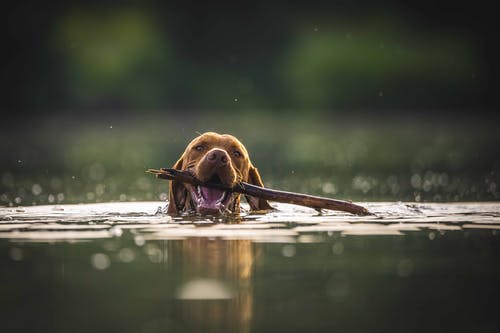
Also, how often does your adorable mutt love a little swim in your local river, stream or pond – especially in the hot summer months? An action that could be directly impacting on the health of the wildlife that lives there. 


              Many dogs love a swim!


So, what are the alternatives to using pesticides for the treatment of fleas and ticks? This is some advice I have found on-line:

Vacuuming is highly effective at removing fleas in any life stage from their favourite haunts: carpets, cushioned furniture, floor cracks and crevices, and pet play structures. Because vacuuming collects fleas but does not kill them, put some tape over the end of the vacuum cleaner hose to prevent fleas escaping from the bag, or transfer the bag to an outdoor waste bin.

Hot, soapy water acts as an effective means to kill fleas in all life stages with no health risk to pets or people. Wash pet bedding weekly to treat an infestation.  Whenever you are handling pet bedding that may contain flea eggs, fold it up carefully so the eggs do not fall out of the bedding and land on the floor or furniture.

Flea combs are made to remove adult fleas, flea dirt, and dried blood from your pet’s skin and fur. They are highly effective, and pets often enjoy the process. Focus on head and neck but groom your whole pet if possible. Pull the fleas out of the comb and drop them into soapy water before they have a chance to jump away. During active flea infestations, grooming twice daily may be needed; otherwise, several times per week just to check for fleas.

A thorough bath using regular pet shampoo and hot water, kills adult fleas as effectively as flea shampoos and dips that contain pesticides and is safer for you and your pet. Before you fill the tub, start by putting a ring of concentrated soap around your pet’s neck, so they cannot escape from the bath water by crawling onto the pet’s head. Cats prefer grooming to baths, but for dogs or long-haired cats, bathing is a superior control technique.

Finally, ask your vet about oral medications for fleas. In general, oral medications are preferable to spot treatments or flea collars. And do not treat your cat, or any dog that lives with a cat, with any pyrethroid or pyrethrin compound as they are extremely toxic to felines. 


Friday, 8 January 2021

Gene Editing


I was interested to read a press release today with the headline “Gene editing creates potential to protect the nation’s environment, pollinators and wildlife”.

Consultation on future of gene editing was launched by the Environment Secretary, George Eustice, at the Oxford Farming Conference today.

A section of the released statement reads:

The way that plants and animals grow is controlled by the information in their genes. For centuries, farmers and growers have carefully chosen to breed stronger, healthier individual animals or plants so that the next generation has these beneficial traits - but this is a slow process.

Technologies developed in the last decade enable genes to be edited much more quickly and precisely to mimic the natural breeding process, helping to target plant and animal breeding to help the UK reach its vital climate and biodiversity goals in a safe and sustainable way.

Gene editing is different to genetic modification where DNA from one species is introduced to a different one. Gene edited organisms do not contain DNA from different species, and instead only produce changes that could be made slowly using traditional breeding methods. But now, due to a legal ruling from the European Court of Justice in 2018 gene editing is regulated in the same way as genetic modification.

The consultation announced today will focus on stopping certain gene editing organisms from being regulated in the same way as genetic modification, as long as they could have been produced naturally or through traditional breeding. This approach has already been adopted by a wide range of countries across the world, including Japan, Australia and Argentina.

Government will continue to work with farming and environmental groups to develop the right rules and ensure robust controls are in place to maintain the highest food safety standards while supporting the production of healthier food.

Potentially, I recognise that gene editing could be a powerful tool within agriculture, offering breeders the potential to wipe out genetic disease, improve drought resistance, boost nutrient efficiency and prolong shelf life, to name but a few benefits.

But as Peter Stevenson, chief policy adviser at the campaigning group Compassion in World Farming said, “the ways in which livestock had been bred for profitable traits in the past suggested the development of gene editing would be harmful to animals. He pointed to genetic selection for broiler chickens, whereby the fast growth rates gave rise to leg abnormalities and lameness, and in laying hens, selecting for high egg production caused osteoporosis, leaving the hens vulnerable to bone fractures”.

Patrick Holden, of the Sustainable Food Trust, said gene editing would “further accelerate the devastating narrowing of the gene pool which has been a feature of post-war farming”.

I would highlight a non-agricultural example to make the decision makers think long and hard before finalising their judgment. Remember, the following has nothing to do with feeding the world, but simply a human trait for what some see as “pleasing to the eye”. Can humans really be trusted with gene editing?

A number of dog breeders have a lot to answer for in my opinion. For instance, Pug dogs are one of the most inbred of all dog breeds. Knee disorders, stomach problems, larynx collapses, elongated soft pallets and breathing problems brought about because of its squashed face are just some of the issues that affects pugs.

Other problems which pugs must put up with are, curvature of the spine and a propensity to suffer from eye injuries, largely caused by a lack of facial structure which would normally protect the dog. The spinal problems are caused by dog breeder’s desire to have a curled tail called a ‘screw tail’.

Pugs have been radically changed through selective breeding


Another example, found in a recent study, is that 70% of Cavalier King Charles Spaniels had syringomyelia by the age of six years. Syringomyelia is the formation of fluid filled cavities in the spinal cord because of abnormalities in the pressure of cerebrospinal fluid due to a mismatch between the size of the brain and the skull or with abnormality of the skull shape. This has been brought on because of the desire by dog show judges for an ever-smaller head size.

Dogs with syringomyelia can show severe signs of pain around their head, neck, and forelimbs and may whine, yelp or cry and contort their necks, become withdrawn, develop a weak or wobbling gait, such that walking becomes increasingly difficult.

Now bear in mind, these problems have been brought about by selective breeding, quite a slow process. Gene editing can fast-forward animal and plant traits extremely quickly.

If you want to find out more and have your say - go to: https://consult.defra.gov.uk/agri-food-chain-directorate/the-regulation-of-genetic-technologies/

Monday, 20 July 2020

Suckers!


It is interesting, but also quite scary, how we are now regularly seeing introduced species bringing in their own associated introduced species with them!

In my garden, I came across these “swellings” on a Bay tree in the back garden. Well, it’s not actually my tree, but a large one that leans over the garden fence with my neighbour – very useful for cooking purposes!! 
    
A quick Google search revealed the culprit behind these swellings to be formed by a Psyllid species called a Bay Sucker (Lauritrioza alacris). Psyllids are also known sometimes as plant lice and are tiny, sap-sucking insects with very host-specific feeding preferences, often resulting in them feeding exclusively on a single type of plant.

Growths produced by the Bay Sucker

The Bay (Laurus nobilis) is one of the oldest shrubs in cultivation and has been grown in the Mediterranean region since Roman times. It was of course used as an addition to cooking, adding its own unique flavour to a range of dishes. It was introduced into this country around the 1650s and is now widely grown, certainly in the milder southern parts of the country anyway.

The little Bay sucker arrived at some point too and is now widely distributed across the country, wherever Bay grows, as this is the only plant that it feeds on.

So, no bother then as the Bay tree is an introduced species and this little sucker is host specific.

Just a thought though. At least 400 insects are known to transmit about 250 different plant viruses, and this is growing all the time. Maybe an introduced virus, carried by an insignificant host such as the Bay sucker, may not be quite so specific and spread to a really important food crop?

It might then become apparent that we are the suckers, for showing so little attention to the wide range of non-native species being brought into this country.

Sunday, 28 June 2020

Tidy, tidy, tidy .........AAAAAAAAH!

Blimey, how fed up am I with the constant noise of strimmers, hedge cutters, mowers and even chain saws. 

The majority of the garden hedges in my village have had their summer trim to make them look tidy. Sod the myriad of insects and caterpillars living there, as well as of course, all those nesting birds. 

Oh, but our garden must look neat and tidy at all times. We don't want anyone in the village to think that we are letting the side down. 

Unfathomably, these nesting birds are of course the same ones that we fed and cared for all through the winter months. Tales are told in the pub of the delight at seeing so many squabbling Goldfinch and handsome Greenfinch feeding on the bird table. How we loved the song of the sweet little Dunnock in spring, the handsome Blackbird that waits each morning to be fed and of course "our"  Robin which has become so tame, it will snatch a meal worm from the hand!

Well guys, tell me where those little birds, yes, those that you enjoy so much from the comfort of your sitting room or kitchen window during the winter months, all come from? 

I will tell you, because it appears that not many of you have given it any thought whatsoever.

Many are currently little babies, sitting in nests, tucked away in hedges and grassy banks. These sites are chosen specifically by the parent birds, because the nests are hidden away by the summer growth canopy.  

That is until you come along and remove that protective green cover, leaving the nest exposed at best, (thanks say the Magpies - so much easier to spot now - yum, yum) or actually smashing the nest up completely with your latest new shiny garden tool.

What about that lovely bank, full of Cow parsley and waving grasses, that has the Robins nest hidden away and where the Slow worm lives? Well that was getting far too scruffy, so a trim was an absolute must. 

I know Slow worms live there, because the owner told me that he "strimmed one up" last year! But despite that - strimmed it was again this year.

Meanwhile, did you know that farmers (the same folk that constantly get blamed for the massive declines in wildlife) are not allowed to cut hedges between March 1st and August 31st? Only areas where growth from a tree or hedge would impinge on health and safety, such as a road junction are allowed to be trimmed. 

I think the same should apply to ALL hedges and trees, wherever they happen to be.

Farmers are not allowed to cut hedges during the summer months


So, come on gardeners and local councils - loosen up on the tidiness fetish, before our country's wildlife becomes even more impoverished. 


Saturday, 20 June 2020

1 million


Congratulations to everyone who signed the NFU petition - it has now gone over the 1 million mark.

We will see if MPs take any notice - they bloody well should! 

Monday, 8 June 2020

National Farmers Union Petition


I have written twice about UK food standards in connection with future trade imports (See below - 16th & 27th May). 

Well, now the NFU has brought out a petition which has already reached 750,000 votes. It would be fantastic to hit one million, so please go to the link below and caste your vote, unless of course you are not particularly fussed about animal welfare.  


https://www.nfuonline.com/news/latest-news/food-standards-petition/ 

Thanks.

Thursday, 4 June 2020

Sexton Beetles


Although a bit of a novice at this, I am getting really fascinated with the family of beetles known as Silphidae – their common names often being Sexton beetles, burying beetles or carrion beetles.

There are 21 species in the UK and the name “Sexton” literally means a person who looks after a church and churchyard, typically acting as bell-ringer and gravedigger. Well, they do the last bit anyway!

Sexton beetles have an exceptionally good sense of smell and can smell a carcass up to a mile away.

I have recently been setting pitfall traps around something “smelly”. A pitfall trap is simply a plastic beaker or pot sunk into the ground, which the beetles then hopefully stumble into and cannot climb out of because of the slippery sides. The smelly thing can be anything allowed to go off somewhat, such as chicken giblets, fish or roadkill!

The offering can be something quite small, such as a mouse, which brings me onto something else of interest. Many sexton beetles carry tiny mites which apparently do them little or no harm. These mites use the Sexton beetles to hitch a lift to these dead food sources.

When both the beetle and mites arrive at a given body, the mites do not eat the dead body, but instead eat fly eggs and larva of anything that is not a carrion beetle. They help to clean the carcass of the potential competitors, so that the Sexton beetle's larva can have the body largely to themselves. That could be important if the food source is no bigger than a mouse!

Here are a few photos showing some of the beetles that I have discovered.  

Black Sexton beetle - Nicrophorus humator - showing a number of mites hitching a lift

Sexton beetle Nicrophorus vespilloides


Oiceoptoma thoracicum - these beetles can sometimes be found sitting on 

Stinkhorn fungus, attracted by the smell


Wednesday, 27 May 2020

We must not allow politicians to negotiate our high standards of animal welfare in Britain away.


Since I wrote about an amendment to the Agricultural bill being voted down in the Commons (See Blog below - May 16th), I have delved a little deeper into why this amendment was defeated.

It appears that the International Trade Secretary, Liz Truss (A former Secretary of State for Environment, Food and Rural Affairs) believes that the UK needs to accept lower standards to strike a deal before the US presidential election in November. Truss believes that the Americans are unlikely to accept any trade deal which does not include complete liberalisation of trade in food.

So, what are the facts about food produced in the USA, and what sort of food may soon be arriving in the UK if Truss gets her way? Let us take a look.

The sale of antibiotics to American farms jumped from 5,559 tons in 2017 to 6,036 tons in 2018 – a 9% rise (latest figures available). Meanwhile over the same period, antibiotic sales in the UK fell by 9% from 248 tons to 226 tons. Experts warn that the routine use of antibiotics on American farms (not allowed here without Veterinary recommendation) risks making once effective medicines for us useless, as bacterial resistance builds. It is reckoned that the US uses a whopping 5 times more antibiotics per animal than in the UK. 

US cattle farmers can use steroid hormones to speed growth by up to 20% - a practice that has been banned in the EU since 1989. 

The biggest US intensive beef farms, known as “Feedlots”, have up to 150,000 cattle kept in out-door pens with little or no shelter, while the largest US mega-dairies boast 30,000 cows.

There are at least two pig farms that each have an astonishing 800,000 animals.
The biggest chicken farms can house a million chickens in vast hanger-like facilities. You can perhaps begin to see why many need to be washed in chlorine to make them OK to eat!

There is no federal US legislation governing the welfare of animals while they are on the farm, and only weak and patchy regulations at State level. The rules governing slaughter are even less detailed and do not exist at all for poultry.

As a result, only 10 States have banned pig sow stalls (banned in EU since 1999) and battery cages for egg laying hens (banned in the EU in 2012) are still widely used.

Since 1997, animals have been recognised within EU law as “sentient” animals – which means that it is acknowledged they are able to feel pain and suffer. In the States there is generally a resistance to acknowledge sentience in farm animals.

Now let us take a look at plant-based agriculture in the States. Just three words might make you think a little – Genetically Modified Organisms (GMOs). GMOs are heavily restricted in the EU but are widely used in the States. For instance, currently 94% of Soybeans and 80% of Maize grown there is genetically modified. Staggeringly, this does not have to be declared on labels.

I could go on about the way that the USA produces food but will leave it there.
In post Brexit trade negotiations, we will of course be dealing with many other countries besides the USA. I can only start to imagine what I might find when I delve into food production in China for instance!

UK farmers are truly dismayed at what could happen over the next few years.

UK farmers care deeply about how their animals are raised

Minette Batters, the National Farmers Union (NFU) president said, “Brexit was meant to be about the creation of a bigger, better Britain, not turning us into a pariah state with no consideration for animal welfare”.

Another NFU spokesman said “UK farmers would be asked a question they would never want to have to answer: Do they just let themselves go out of business or do they just lower their standards. In other words – a race to the bottom”.

What do the general public think about all of this? Well, the first thing to say is that most do not know what is happening, because the ONLY news currently being provided is about Covid 19. How convenient for the Government.

However, according to a Which poll, 93% of Britons want our high food standards to be protected in post-Brexit trade deals. So naturally, one would imagine that our elected politicians would follow the will of the public and vote accordingly.

DON’T BE NAIVE.

The Tories were totally to blame for this amendment failing. It is obvious that pressure is being applied from on high as even George Eustice, Defra secretary and MP for Camborne and Redruth and Defra farm minister Victoria Prentis, who is Conservative MP for Banbury, voted against the amendment. Ms Prentis attempted to allay fears that UK farmers will be undermined in any future trade deals.

Ms Prentis said: “I was elected on a very clear manifesto commitment – one that the prime minister has reiterated since – that in all our trade negotiations we will not compromise on our high environmental protection, animal welfare and food standards. This government will stand firm in trade negotiations to ensure that any deals live up to the values of our farmers and consumers.”

That last line says it all. As wishy washy as they come. If they meant what they said, they would have no hesitation whatsoever of supporting this amendment. But of course, they do not.

What can you and I do about this dreadful situation? If, like me, you feel that the Government is betraying the British public and perhaps more importantly, our farmers and farm animals, then we need to shout out our disgust – very, very loudly.

You are most welcome to forward this blog (and the one on the 16th May) to whoever you feel might be interested (93% of Brits apparently!). Also contact your MP and write letters to newspapers etc.

The Bill will be voted on in the Lords on the 10th June, before going back to the Commons for a final vote. Post Brexit, these trade deals are obviously hugely important, but sometimes the cost is too high and we need to stand up for what is right.

Over to you.


Tuesday, 19 May 2020

Phragmidium rosae-pimpinellifoliae. Now that's a name and a half!


I came across this outstandingly orange fungus yesterday. I could see it way ahead of me as I walked along the path, and immediately thought that someone had thrown their discarded orange peel in the hedge! 

On closer inspection though, I found that it was in fact a rust fungus, that goes by the snappy name of Phragmidium rosae-pimpinellifoliae, which occasionally infests the wild Burnet rose. 

The Burnet rose (Rosa pimpinellifolia) can be seen in flower in Britain and Ireland from May until the end of August and are the thorniest of all the wild roses. 

They have five-petalled white flowers, sometimes splashed with a little pink. They can look a little like wild Dog Rose, but later in the year, their hips are coloured purple, unlike other wild roses which have red or scarlet hips.


The strikingly coloured Burnet Rose rust
I'm glad that I do a written Blog rather than a spoken one, as I would have to practice how to say the scientific name of this fungus for some time to get it right!


Monday, 18 May 2020

A walk in the sun produces three very different insects!

I took an enjoyable walk through my local wood yesterday, camera in hand! This is a small selection of what I saw.

   
Figwort weevils seemed to be on about 8 out of 10 Figwort plants! They are often not that much larger than an apple pip, so you have to look quite hard for them! Having found one, you then can't be too clumsy as you approach them, because, if they think that they are in danger, they just "let go" and fall to the ground. A good tactic, as they are then very difficult to spot again! 


What a design! The Figwort Weevil.

Then I came across this stunning little Froghopper - a Red & Black Froghopper. They happily sit out in full view of everyone as their colouration of red (or maybe orange?) & black, warns anything looking for a meal that they taste horrible! 


The Red & Black Froghopper - Cercopis vulnerata

As the sun started to warm up the day after quite a cold night, then Speckled Yellow moths started to fly around. I counted well over dozen or more, many of which I followed trying to get a photo of them once they had landed. They are very jumpy and launch into flight at any sudden movement, or should you happen to caste a shadow across them. 

Eventually, one obliged and stayed still for long enough for a few shots!

Three striking little insects - and all so different from each other.  

A Speckled Yellow - a day flying moth

Saturday, 16 May 2020

Are you concerned about animal welfare and how the food you eat is produced? Our elected MPs don't appear to be.


British farmers have amongst the highest farm animal welfare standards in the world. That is not to say that they could not be improved, as we should always be striving to raise standards.

Brexit has given us an ideal opportunity to manage not just our animal welfare standards, but ALL our farming practises, strengthening them more and more so that we become, without question, the best in the world.

The National Farmers Union (NFU), headed up by the excellent Minette Batters, has pushed extremely hard for this, saying “British farming can be the envy of the world”.

At the end of January 2020, she wrote a letter to the Prime Minister which included a paragraph as follows:
You have pledged “not to in any way prejudice or jeopardise our standards of animal welfare or food hygiene”, and the Secretary of State for Defra recently promised to “defend our national interests and our values, including our high standards of animal welfare.” Along with your party’s manifesto commitment that, “in all of our trade negotiations, we will not compromise on our high environmental protection, animal welfare and food standards,” we are increasingly reassured that you are as committed as us to making the UK a world leader in food, farming and environmental standards.

Aberdeen Angus in the UK - a scene just three fields away from my home in Wiltshire.   

So, when the Agriculture Bill - the biggest reform of British farming since 1945 - was put before MPs last Wednesday (13 May), for the final time, as it had reached the Report Stage and Third Reading, we hoped that all would be confirmed as stated.

To absolutely make sure of this, an amendment was tabled by Tiverton and Honiton MP Neil Parish, who is also chairman of the House of Commons Environment, Food and Rural Affairs Committee “to protect farmers from lower-standard food imports”.  
He said “I want to have great trade deals – I am not a Little Englander that will defend our agriculture against all imports – quite the reverse.

However, despite the government's previous commitments to safeguard the industry, the amendment was defeated by 328 votes to 277 and then the whole Agriculture Bill later passed its third and final reading by 360 votes to 211. So, it now goes on to the Lords.

Mr Parish said it was 'disappointing' and that many in the Commons' now have 'grave concerns' over the direction of travel the Bill is going in.

NFU Cymru president John Davies said, "The bill should ensure that agri-food imports are produced to at least equivalent environmental, animal welfare and food safety standards as those required of producers in the UK.

There now could be a 'very real risk' that British farmers are undermined by agri-food products produced to standards which would be illegal in the UK. The UK cannot have a trade policy which requires farmers to compete against food produced to lower standards”.

To me this beggar’s belief.

Are we as a nation saying two things here?

On the one hand we demand that “all UK farmers must treat livestock (and all Agri-food products) to very highest standards, always following best practice and the letter of the law”.

Meanwhile, on the other hand we are also saying to importers “do not worry too much about how food is produced abroad, just bring it on in. We can easily turn a blind eye to the fact that the way it was raised, would be illegal here”.

I will leave you to decide if this is in any way an ethical way to behave.   


Wednesday, 13 May 2020

Butterflies galore!


One problem with having a run of consecutively warm and sunny days, is that the photos you take tend to sit on the laptop, without being "sorted out"! I struggle to remain indoors at the best of times, so things have to wait until a day dawns that is grey and not particularly inviting! Then I can go through photographs and sort out the wheat from the chaff. 

Hence these photos are from last week!

There was one day when the weather was particularly warm and sunny, so I took a walk to a lovely little area of Chalk Downland that I know. Spring butterflies abounded, and these following pictures are of some of the species that I caught up with.  

The Green Hairstreak is a stunning butterfly, which always rests with its green wings shut, so that you really only ever see the under-side of the wing.

Green Hairstreak

I always think that Grizzled Skippers are feisty little butterflies, always alert and ready to do another sortie of the immediate area. 

Grizzled Skipper

A freshly emerged Brown Argus is a lovely butterfly. They can turn up in all sorts of places, so it is always worth keeping a lookout for them. 

Brown Argus

The Marsh Fritillary is a butterfly of high conservation priority, as it has not fared well in the UK (or indeed across Europe). It's caterpillar's main foodplant is Devil's-bit Scabious, a plant which itself is not that common. But when you do find them - what a beautiful butterfly - rather like a living, jazzy stain-glass window!     

Marsh Fritillary


It's a shame to have to go through life being described as "dingy"! I suppose it is a little, when compared to the other members of the Skipper family - but the Dingy Skipper gets the thumbs up from me - I think that they are great little butterflies! 

Dingy Skipper

And finally, one of my favourites! What a vibrant colour combination the Small Copper has, bringing a flash of brilliance to the countryside wherever it chooses to settle!

Small Copper

Tuesday, 12 May 2020

Bugs, Spiders & Flowers


Some finds that I have come across in the last few days. 

I found this Cinnamon bug, pootling around on a Dandelion seed head. I love delving down into their world a little, as the picture becomes much more than just a wonderfully coloured bug! The seed head is amazing in its own right. 


A Cinnamon bug

Then my eye was drawn to this superb little Wild Strawberry flower, which seemed to have a particularly orange centre. I pass many of these small plants as they are fairly common here in Wiltshire, but once they are viewed up close, they perhaps have an even greater beauty.  I rather like the slight blemishes on the white petals, as none of us are perfect!

The lovely little flower of Wild Strawberry

Quite a common spider, but an exotic looking one nevertheless! The name is fun too - the Common Cucumber Spider!


The Common Cucumber Spider


Tuesday, 5 May 2020

Whitethroats


Absolutely not scientific in any way, but I think that the Whitethroat seems to be doing well.

Last year, a section of a track way, with bits of hedge and scrubby areas on each side, that takes me about 10 minutes to walk, revealed 3 Whitethroat. This year, the same walk seems to be holding 7 singing males.

In the winter of 1968/69, Whitethroat numbers suddenly crashed due to a severe drought on their wintering grounds, which are just to the south of the Sahara desert. Since then a slow but relatively steady recovery has taken place. It demonstrates how, just a one year severe weather change can radically affect a species - sometimes in a positive way, but also in a devastating manner.

A Whitethroat singing its short burst of scratchy notes


Whitethroat are fairly easy to spot, as often the male will sit on a vantage point right at the top of a bush, to shout out his rattling, rather hoarse song. Occasionally, he will also take off and fly up vertically, then drop back down to his perch, singing away throughout the display. This is undoubtedly a performance to impress the girls and also to confirm that this area is HIS territory!     


Whitethroat can be seen and heard throughout the UK, especially on farmland with an abundance of hedges and scrubby areas. Although the male is easily spotted, the female and her nest is a different matter. The nest is usually on or close to the ground, hidden away in in thick grass or low bramble. 


My sister, who lives in Worcestershire, told me that she thought that there were not quite as many Whitethroat around as last year. So, who knows, we will obviously just have to wait and see what the British Trust for Ornithology (BTO) figures show us at the end of the year. 

Anyway, in the meantime, I will thoroughly enjoy walking my "Whitethroat track" in the mornings this summer!     


Friday, 1 May 2020

Looking back over the making of the British landscape

I am currently reading a fascinating book called “The making of the British landscape” by Nicholas Crane, which kicks off way back in the Ice Age and runs through right up until the present day.

I have learnt so much by reading this book. For instance, take the reign of king Ine - the king of Wessex between 689 – 726 AD. His kingdom actually covered a lot more than the Wessex we know today, in fact most of southern England came under his influence.

At this time, small, informal congregations of people, who felt that their food security could be increased by sharing and managing an acknowledged neighbourhood area, started to work together, encouraged by the king. Clusters of farmsteads decided to manage common crops, woodland, hire oxen, avoid local conflict between each other and collectively pay church dues and so on.

Now, those of you have read my Blog for a period of time, will know that I was actively involved in helping to get farmers to work together across a landscape, so as to collectively try to improve their soil, water and wildlife.

Farmers have embraced this idea and it has really taken off across England, with well over a hundred “farmer clusters” now in existence, all working together and funded to do so by Government.

We all thought that we were clever to do this - forging a new way ahead. Little did we know that this brilliant idea of ours was common practise around 700 AD!!

Two more little snippets from this book that I would like to share with you. 

John Leland, (1503 - 1552) who has often been described as "the father of English local history and bibliography", wrote about a little place called Bremischam in the Midlands. “A good market towne, with many smithes that make knives and all maner of cuttynge tooles, as well as a greate many naylors”. 

He judged that most of Bremischam’s economy was based on smiths. He concluded that Bremischam was doing well; small and beautiful.

Bremischal would become Birmingham. 


Birmingham today has a population of 1.2 million!

By 1550, London had reached a population of 75,000. 

Set against European cities, London was not numerically remarkable. Naples was nearly three times larger at 212,000, Venice had a population of 158,000 and Paris 130,000. The world’s biggest city at the time, Beijing, had already passed the half-million milestone.

By 1600, London was some thirteen times bigger than Britain's next largest city, Norwich. 

One of the most desirable places to live near London was a riverside village called Chelshithe, which was close to roman roads heading west and very convenient for access into London. Thomas More built himself a red brick house here, with bays, a porch and flanking casement windows, set in a 14-hectare (35 acre) estate with access to the river.

It was a good address. There were views across the water to the woods and fields of Battersey and from a rise in his garden, More could see the distant roofs of London and St.Pauls. It was also positioned upwind of the city and so Chelshithe was famed for its clear airs.

Imagine if you still owned a 14-hectare estate in Chelsea today!

I am only two thirds of the way through this book, so I will probably share some more great snippets with you over the next week or so.